Ma (間) and Why Your AI Workflow Needs It
There is a concept in Japanese aesthetics that has no precise English equivalent. It lives in pauses. It operates in gaps. And it might be the thing your relationship with AI is quietly destroying, not all at once, but one skipped step at a time.
Miles Davis and the Space He Left Open
I was listening to Miles Davis on a late Tuesday night, turning something over in my mind, when I noticed something I had never quite registered before.
The silences.
Davis does not rush to fill the space between phrases. He lets the note decay, lets the room hold it, lets something accumulate in the gap before the next sound arrives. It is not hesitation. It is not a legend running out of ideas. The silence is doing something. It is working at least as hard as the sound, maybe harder.
I have been thinking about that gap ever since. Not because of music theory. Because of a conversation I had the next morning with an AI assistant, where I asked it to help me untangle a problem I had been sitting with for weeks. Within seconds, I had a perfectly structured framework in front of me. Seemingly comprehensive, logical, and complete.
And something in me deflated.
There is a Japanese concept for what was missing. It is called 間 — ma. And I think it might be one of the most important ideas nobody in the technology industry is actually reckoning with.
What Ma Is (And Is Not)
“Ma (間)” is usually translated as “negative space.” That translation loses something critical.
Negative space suggests an absence. A background. Something that simply is not there. Ma is not an absence. It is a presence of a different kind.
In Japanese aesthetics, ma refers to the meaningful pause, the intentional gap, the space between things that gives those things their definition and power. A musical rest is ma. The silence before a Noh actor speaks is ma. The empty wall beside the single scroll in a tea room is ma. The pause a master holds before moving is ma. The approach path to a shrine that takes three times longer than necessary, because arriving is part of what you are being prepared for — that is ma too.
What these share: ma is not passive. It is generative. The gap does not merely separate two things. It creates the conditions for meaning to arise between them.
This is categorically different from inefficiency.
What Gets Lost When You Remove It
Here is what a workflow optimized entirely for speed and output feels like from the inside.
You have a question. You ask it. You receive an answer. You have another question. You ask it. You receive another answer. The throughput is extraordinary. The ground covered is vast.
And at the end of the session, something strange: you feel simultaneously full and somehow not nourished. The answers came too fast to absorb. The thinking happened somewhere else and was handed to you pre-digested.
But here is the part I want to be honest about, because it took me a while to name it.
The answers got faster. They also got more correct, in a certain sense. Better structured, better supported, more complete. And yet somewhere along the way, they stopped being my answers. What I was producing was not my opinion — it was something that sounded right. Something optimized toward correctness rather than grown from the specific friction of my own experience and reasoning.
I noticed it first in small ways. A take that was well-argued but felt slightly foreign. A conclusion I could defend but not quite feel. The reasoning was there. The gut feeling was not. And I realized: the gut feeling is not decoration. It is what gets built in the gap, during the part of thinking I had been skipping.
This is not a failure of the AI. It is doing exactly what it was designed to do. It removes friction and optimizes the gap.
But ma is a gap that was doing work.
The Muscle You Cannot Build by Skipping the Process
I run. I train every day, and I have run ultras — distances where the only thing keeping you moving in the final hours is something that was not installed during the race itself. It was built in all the sessions before it, in the accumulated weight of showing up when it was inconvenient, in the specific education of learning what your body does under load.
There is a version of training that optimizes only for appearance. Certain substances can accelerate muscle growth to a degree no natural process can match. The result looks like strength. It may not translate to actual athletic performance, and it bypasses the adaptive process entirely, the physiological reasoning, if you want to call it that, that happens when the body is placed under genuine stress and allowed to respond.
I think about this when I think about what has happened to my thinking over the past couple of years with AI tools. The outputs got bigger, faster, and more impressive-looking. The underlying capacity — the ability to sit in a difficult problem and reason my way through it without a scaffold — atrophied in ways I did not notice until I needed it.
Shunryu Suzuki, the Zen monk and teacher known in the US, put it differently: “In the beginner’s mind there are many possibilities, but in the expert’s mind there are few.” What he was describing is what happens to thought when we stop making space for not-knowing. The gap is not the inefficient part you suffer through on the way to the answer. The gap is where the learning actually happens.
You cannot outsource the reflection that turns information into understanding. The process of thinking something through is not the delay before the insight. It is the insight.
Ma in the Things We Make
The same logic is built into the objects Japanese craft has produced for centuries. You can see it most clearly when you know what to look for.
Consider the tokonoma, the alcove in a traditional Japanese room — which displays a single scroll and perhaps one ceramic vessel. The rest of the wall is empty. The Western instinct is to treat that wall as a surface not yet used. But the empty wall is load-bearing. The scroll has meaning because of the silence around it. Remove the emptiness, and you destroy the focus. The ma is the curation.
Now look at a typical software interface. The drive is almost always toward filling every moment of possible attention, the unread badge, the infinite scroll, and the recommendation that appears before you have finished processing what you just consumed. There is no ma in this design. And there is a cost that rarely appears in the metrics.
A Rough Framework (That I Use on Myself)
I want to be careful here not to suggest that all gaps are worth preserving. Some friction is just friction. So here is the distinction I keep returning to:
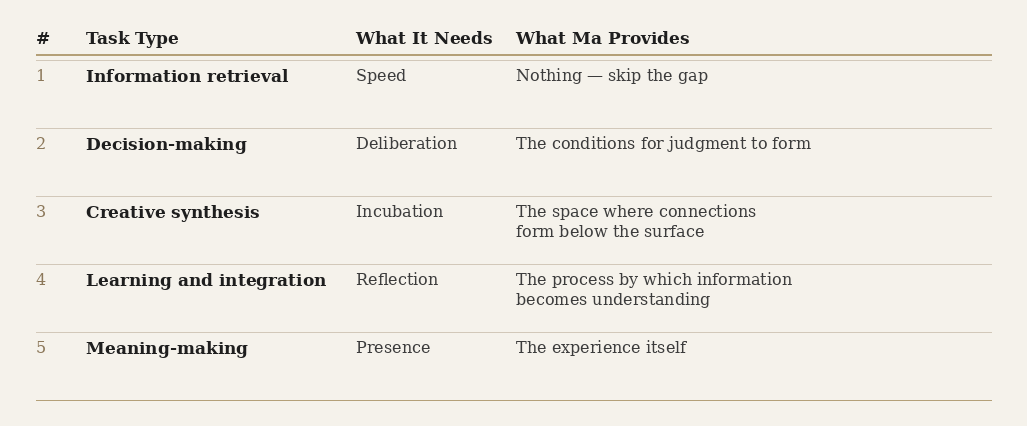
To make this concrete:
- Information retrieval — Asking an AI to summarize a research paper. Use it, move fast, no gap needed.
- Decision-making — Asking it to help you think through a job offer. The tool can surface considerations you missed, but the deliberation has to happen in you, not in the output.
- Creative synthesis — Asking it to generate ideas for a project. Useful as raw material to react against, but the connections that actually matter, the unexpected ones — form in the silence after you close the screen.
- Learning and integration — Reading something that challenges how you think. The AI can explain it, clarify it, even quiz you on it. What it cannot do is wait while the idea slowly rewires something. That happens on a run, in the shower, in the gap between encountering something and understanding it.
- Meaning-making — Trying to process an experience that changed you, or figure out what you actually believe. No amount of well-structured output will do that work for you.
The mistake I think many of us are making with AI tools right now is applying them uniformly across all five. It is an extraordinary instrument for the first. Genuinely useful for the second and third, with care. But the fourth and fifth require something the tool cannot give: time spent in the gap.
Keep skipping that, and something atrophies. Not dramatically. Quietly. The way a muscle does when you stop asking it to work.
The Hardest Ma to Sit With
There is a version of this that has nothing to do with AI, and it is considerably more complicated.
The gap that is hardest to hold is not the one in a workflow. It is the one between people.
In a tea room, the silence is designed. The empty wall was placed there with intention, by someone who understood what they were creating. The visitor receives it as a gift, even if they cannot name it. The ma is mutual.
But human communication does not work this way. A message sent, a response not yet arrived — that silence is not designed. It just exists, and the moment it exists, the receiving person begins to fill it with meaning. Too many meanings, shifting meanings, meanings that have nothing to do with what is actually happening on the other side. We are meaning-making creatures, and we cannot turn it off. Each person carries a completely different threshold for how long a silence can last before it starts to feel like something other than silence.
This is where ma becomes genuinely difficult. The concept asks us to hold the gap open, to resist the impulse to close it prematurely. And I think that is right, for the most part. But there is a version of that gap — the unintentional one, the silence that was never meant to say anything — that can do real damage without anyone intending it. Not because the silence was designed to hurt, but precisely because it was not designed at all.
We are imperfect. That is fine. Imperfection is, in a certain sense, what this whole project is about. But there is a difference between the imperfection of a cracked bowl repaired with gold and the imperfection of a silence that lands on someone as abandonment. One carries history honestly. The other just causes harm.
Ma in craft is intentional. Ma between people requires something harder than intention: awareness of the other person’s relationship to silence, which is never the same as your own. Too fast and the gap never opens. Too slow and it becomes something neither person chose.
What Davis Knew
There is a concept in music theory called negative space, and it describes exactly what Davis was doing on that record: using silence as a compositional element, not as the absence of music but as a different kind of music. In this reading, silence is not the interruption of sound. The silence is the expression.
Okakura Kakuzo, writing about the tea ceremony in 1906, made the same point from a different angle. The tea room holds its own incompleteness as a form of openness. The unfilled space is not wasted. It is an invitation extended to whoever enters.
I wrote about this in my piece on wabi-sabi — the idea that incomplete things invite participation because they create ma. They make the gap explicit. And in doing so, they remind you that you are someone capable of completing something, of contributing something, of being present in the making of meaning rather than simply receiving it.
A perfectly complete, perfectly optimized AI response creates no such gap. There is nowhere to enter. The thinking has already happened. The conclusion has already been drawn. You are not a participant. You are a recipient.
The craftspeople I write about in this space are not preserving the past. They are demonstrating a different theory of value: that the process is not the inefficient part you endure on the way to the result. The process is what makes the result mean something. The object made with friction has a relationship with its maker and its user that the optimized object cannot achieve.
The clay pushes back. The gap holds open. The silence between the notes is doing work.
That is not a bug. That is how you stay the one doing the thinking.
FAQ
Q: What is ma (間), and how is it different from “negative space”? A: Ma is an active concept, not a passive one. It refers to the meaningful pause or intentional gap that creates conditions for perception, connection, and meaning to arise. Unlike negative space in Western design — which typically means background or absence — ma is understood as a presence of a different order. It is the silence that makes sound audible, the gap that gives surrounding objects significance, the pause that allows the next moment to arrive with full weight.
Q: Why does ma matter specifically for AI workflows? A: Because AI tools are intended to minimize gap and maximize throughput, which is ideal for certain tasks and genuinely costly for others. Learning, creative synthesis, and meaning-making all require what we might call incubation time — periods of productive uncertainty where the mind is doing something that cannot be rushed or outsourced. Ma is a framework for identifying which gaps are doing work and protecting them from the optimization impulse.
Q: Is this an argument against AI tools? A: No. It is an argument for using them with more precision — and more self-awareness about what gets built in the gaps they remove. The claim is not that the tools are harmful. It is that applying them uniformly to all cognitive tasks trades away something valuable without registering the cost. Keep skipping the gap in the right places, and what atrophies is not productivity. It is judgment.
Q: How does this connect to the broader engawa thesis? A: Ma is one of the structural concepts underlying the whole argument. If context is the accumulated residue of intention, process, and time — which is the claim I keep returning to across these essays — then ma is the space in which context accumulates. An optimized process that removes all gaps also removes the space where the depth of experience forms. That is true of a tea ceremony, a piece of craft, a training run, and a thinking process alike.
Taishi Okano writes about the intersection of technology, craft, and culture at engawa. This is part of an ongoing series exploring what we lose — and what we preserve — at the edges of optimization.
Related: Wabi-Sabi in the Age of Perfect Algorithms | In Praise of Friction | How a 400-Year-Old Tea Ceremony Predicts the Future of UX